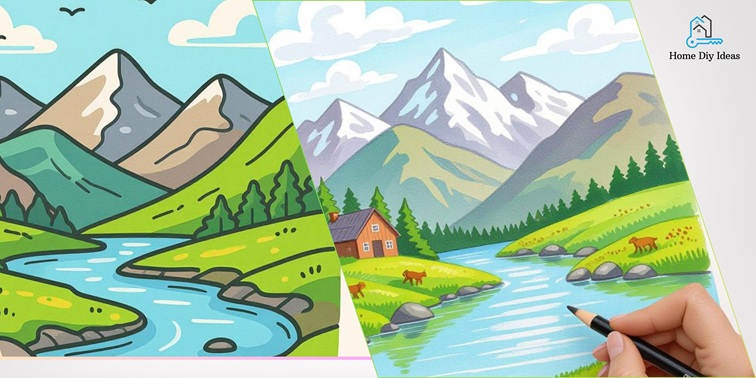

Drawing landscapes is one of the most rewarding artistic pursuits — it invites you to observe nature, understand composition, and express emotion through line and tone. Yet for many beginners, the vastness of a scene and its countless details can feel intimidating.
In this guide, you’ll discover clear, practical steps on how to draw landscapes, supported by expert insights, checklists, and actionable exercises to help you move from blank page to finished artwork.
Why Learning to Draw Landscapes Matters
Drawing landscapes helps develop visual awareness and discipline. It teaches you to simplify complex scenes, understand spatial depth, and train your hand–eye coordination. Whether you draw for relaxation, study, or design work, landscape sketching strengthens your artistic foundation.
Getting Ready — Materials, Mindset & Setup
Materials Checklist
| Item | Purpose |
| Sketchbook (A4 or 9″×12″, medium-weight paper) | Provides a consistent surface for practice. |
| Graphite pencils: HB, 2B, 4B | Range from light to dark values. |
| Erasers (kneaded and standard) | For highlights and corrections. |
| Ruler or straight edge | Helps with composition and horizon line. |
| Sharpener | Keeps pencil tips precise. |
| Blending stump or tissue | Softens tonal transitions. |
| Optional color pencils or markers | Add tone or color variation once you’re comfortable. |
Mindset & Planning
- Start simple: Choose an uncomplicated subject — a tree line, hills, or a lake view.
- Use light pencil pressure: It’s easier to adjust composition later.
- Warm up: Spend 5–10 minutes sketching small scenes to loosen up.
- Set clear goals: Focus on one skill at a time — composition, shading, or texture.
Step-by-Step Guide: How to Draw Landscapes
Step 1 – Observation & Thumbnails
What to Do:
Observe your scene or reference. Identify the horizon line and large shapes like sky, land, and trees. Create 2–3 small thumbnail sketches exploring composition options.
Checklist:
- ☐ Horizon line identified
- ☐ 2–3 thumbnails made
- ☐ Best composition selected
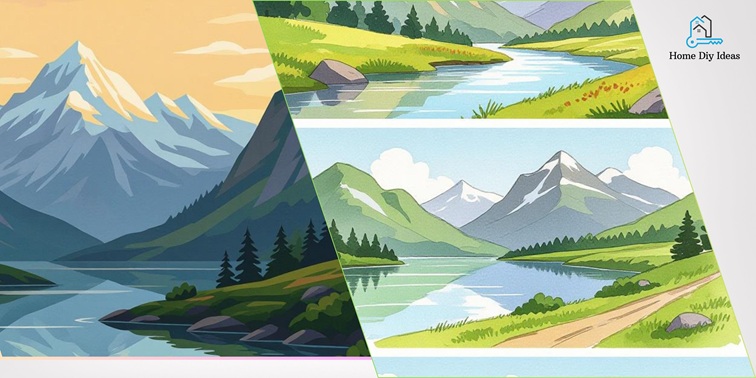
Step 2 – Define Composition and Proportion
What to Do:
Lightly mark your horizon line and divide the scene into foreground, middle ground, and background. Compare proportions — how tall is the tree compared to the house? How wide is the hill compared to the river?
Checklist:
- ☐ Horizon line drawn
- ☐ Foreground/midground/background marked
- ☐ Proportions checked
- ☐ Focal point chosen
Step 3 – Block Shapes and Values
What to Do:
Using a 2B pencil, block in large shapes — mountain silhouettes, tree masses, land areas. Decide on value zones: light (sky), mid-tone (distant hills), dark (foreground).
Tips:
- Avoid detailing too early — focus on light vs dark.
- Value contrast creates depth and realism.
Checklist:
- ☐ Major shapes blocked
- ☐ Values assigned (light/mid/dark)
- ☐ Composition balanced
Step 4 – Add Texture and Details
What to Do:
Now define textures — grassy strokes, bark lines, or water ripples. Use a softer pencil (4B) for shadows and depth. Keep distant elements softer and lighter, with more detailed strokes in the foreground.
Checklist:
- ☐ Textures applied
- ☐ Shadows deepened
- ☐ Foreground detail emphasized
- ☐ Background simplified
Step 5 – Final Adjustments
What to Do:
Review your drawing. Use an eraser to highlight sunlit areas or reflections. Deepen shadows where necessary and refine your focal area.
Checklist:
- ☐ Highlights added
- ☐ Shadows balanced
- ☐ Focal point clear
- ☐ Artwork signed and dated
Practical Tips for Beginners
1. Use a Grid for Accuracy
If proportions are tricky, lightly grid your page to align elements accurately. This improves spatial accuracy and reduces distortion.
2. Simplify What You See
Don’t draw every leaf or stone. Focus on large shapes and tonal contrasts — detail selectively where it matters most.
3. Build Depth with Value
Use darker tones in the foreground and lighter tones in the distance. Overlap shapes to reinforce depth.
4. Practise Mini Studies
Do quick 10–15 minute sketches. Frequent, smaller sessions improve your confidence and line control faster than long sessions.
5. Keep a Sketchbook Routine
Draw regularly — even short daily sketches help train your observation and technique.
Quick Landscape Drawing Checklist
- ☐ Select a simple subject
- ☐ Create 2–3 thumbnails
- ☐ Define horizon and focal point
- ☐ Mark three depth zones (foreground, midground, background)
- ☐ Block in values
- ☐ Add textures and shadows
- ☐ Refine focal details
- ☐ Clean up and sign your work
Frequently Asked Questions
You might not be separating foreground, middle, and background effectively. Use lighter tones and less detail in the distance; add darker, sharper details in the foreground.
No. A few good pencils, paper, and an eraser are enough. Mastering fundamentals is more important than tools.
Aim for suggestion rather than perfection. Focus on main forms and values; over-detailing can make your drawing cluttered.
Both are useful. Real life improves observation; photos help control lighting and time.
Use sight-measuring or a simple grid. Compare relative sizes and angles before committing lines.
Conclusion
Learning how to draw landscapes is not about perfection — it’s about observation, simplification, and steady practice. Every line teaches you something new about nature’s shapes and rhythm.
So, grab your sketchbook and choose a simple scene — maybe your garden, a local park, or a distant hill. Follow the checklist, take your time, and enjoy the process.