Capturing the beauty of the outdoors through landscape photography is both an art and a technical skill. It’s where creativity meets patience — where light, perspective, and composition transform ordinary scenes into breathtaking imagery. Whether you’re shooting rolling hills, serene lakes, or your own landscaped garden, knowing how to harness natural light and environmental details can make all the difference.
In this guide, I’ll share professional landscape photography techniques grounded in real-world experience, along with insights drawn from a content gap analysis of the top-ranking competitors. By the end, you’ll know how to capture stunning outdoor images that convey depth, mood, and emotion.
Understanding the Art of Landscape Photography
Landscape photography is not just about capturing land — it’s about translating feeling into frame. Every shot tells a story: the whisper of the wind, the color of the sky before rain, or the symmetry of a well-manicured garden.
In landscaping, we design balance and flow. In photography, we capture it. The two are deeply connected. When you understand design principles — such as line, texture, and proportion — your outdoor shots become intentional and emotionally resonant.
Essential Gear for Outdoor Landscape Photography
Before heading outdoors, ensure you have the right setup. You don’t need to spend thousands, but a few key tools can elevate your results dramatically.
Must-Have Equipment Checklist
- Camera – A DSLR or mirrorless camera with manual settings for greater control
- Lens – Wide-angle (16–35mm) for vast views; telephoto (70–200mm) for distant landscapes
- Tripod – For stability and long exposure shots
- Filters –
- Polarizing filter: reduces glare and enhances sky contrast
- ND filter: enables long exposures in bright light
- Remote shutter release – Prevents camera shake
- Lens cleaning kit – Keeps glass spotless in outdoor conditions
Pro Tip: I always carry a microfiber cloth and a few lens wipes — dust and moisture can ruin an otherwise perfect frame.
How Lighting Shapes Your Landscape Photos
Light is the heart of landscape photography. The same scene can appear entirely different at sunrise, midday, or dusk.
Best Times to Shoot
| Time of Day | Lighting Quality | Ideal Scenes |
| Golden Hour (after sunrise, before sunset) | Warm, soft shadows | Mountains, gardens, beaches |
| Blue Hour (before sunrise, after sunset) | Cool, moody tones | Lakes, cityscapes, forests |
| Midday | Harsh light | Water reflections, dramatic contrasts |
| Overcast | Even lighting | Forest trails, waterfalls, macro details |
I often shoot gardens and lawns during the early golden hour — the soft light enhances foliage colors and highlights landscape textures beautifully.
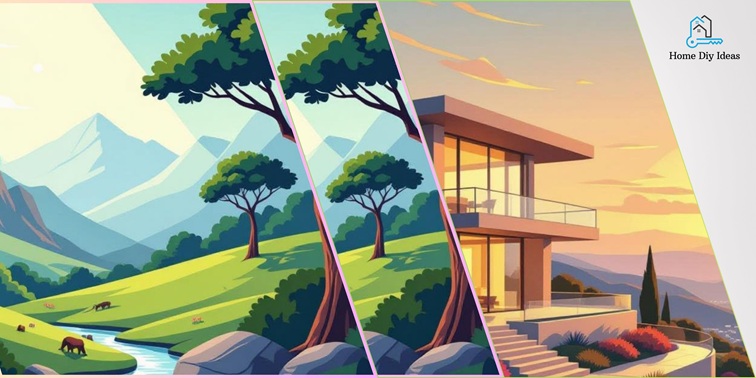
Composition Techniques for Stunning Outdoor Shots
The best photographers don’t just shoot — they compose with purpose.
Here are some proven techniques to elevate your landscape images:
1. Rule of Thirds
Imagine a grid over your viewfinder. Place key elements (trees, paths, horizon) along these lines or intersections for balanced framing.
2. Leading Lines
Use roads, rivers, or garden pathways to draw the viewer’s eye toward your focal point.
3. Foreground Interest
Add rocks, flowers, or shrubs in the foreground to create depth and a sense of scale.
4. Framing the Scene
Use natural frames like arching trees, fences, or structures to focus attention on the main subject.
5. Depth and Layers
Combine foreground, midground, and background elements to create dimensional storytelling.
My personal approach: When photographing landscaped spaces, I often crouch low to include textured ground plants — this adds a tactile realism to the frame.
The Role of Weather and Seasons in Outdoor Photography
Each season tells its own story. A seasoned landscape photographer learns to read the sky like a map.
Seasonal Shooting Tips
- Spring: Capture fresh growth, soft light, and blooming landscapes.
- Summer: Watch for harsh light; use ND filters for long exposures.
- Autumn: Play with warm tones and contrast against clear skies.
- Winter: Utilize fog, frost, and minimalism for serene compositions.
Cloud cover, rain, or mist can enhance drama. Don’t shy away from less-than-perfect weather — sometimes, that’s when magic happens.
Integrating Landscaping Principles into Photography
If you’ve designed or maintained gardens, you already understand visual harmony. Apply those same landscaping rules to photography:
| Landscaping Principle | Photography Application |
| Balance | Distribute visual weight using symmetry or contrast |
| Focal Point | Lead attention to one key subject (like a tree or sculpture) |
| Repetition | Use repeating patterns — fences, flower beds, or trees — to build rhythm |
| Texture | Highlight rough bark, smooth water, or layered foliage |
| Color Theory | Use complementary tones to evoke emotion and unity |
By blending landscape design awareness with camera skills, you’ll not only photograph scenes — you’ll tell their stories authentically.
Editing for Natural Beauty
Post-processing should enhance your photo’s truth, not distort it.
Recommended Workflow:
- Adjust Exposure – Correct overall brightness without overexposing highlights.
- Enhance Contrast – Deepen shadows slightly for dimension.
- Refine Colors – Boost greens, blues, and earth tones subtly.
- Sharpen Selectively – Emphasize textures like leaves or rocks, not the entire image.
- Crop Thoughtfully – Strengthen composition without losing story elements.
I use tools like Lightroom and Luminar Neo, but even mobile editors can achieve beautiful, natural finishes when used with restraint.
Common Mistakes to Avoid
- Shooting only at eye level — experiment with height and angles.
- Ignoring the foreground — it anchors your image.
- Over-editing colors — leads to artificial tones.
- Forgetting about weather changes — always check forecasts.
- Using too wide an aperture — landscapes need depth of field (f/8–f/16).
Quick Landscape Photography Checklist
✅ Fully charged batteries
✅ Clean lens
✅ Tripod ready
✅ Filters packed
✅ Manual mode on
✅ ISO low (100–200)
✅ Aperture set for depth
✅ Check horizon straightness
✅ Shoot in RAW for best editing flexibility
FAQs About Landscape Photography
Use manual or aperture-priority mode, ISO 100–200, aperture f/8–f/16, and a tripod for sharp detail.
Not necessarily. Even a mid-range DSLR or mirrorless camera can capture professional-quality results with the right composition and lighting.
Include leading lines, add foreground depth, and shoot during golden or blue hour for natural mood.
Wide-angle lenses (16–35mm) are ideal, though telephoto lenses (70–200mm) can isolate distant landscapes beautifully.
Always shoot in RAW for maximum control over exposure, color, and contrast during editing.
Conclusion
Landscape photography is more than technique — it’s connection. When I photograph a landscape, I’m not just documenting scenery; I’m interpreting its energy, rhythm, and life.
Each image is an invitation to pause, reflect, and appreciate the planet’s artistry. So grab your camera, step outside, and let your lens become a bridge between earth and emotion.