When I first stood before one of Van Gogh’s landscapes—perhaps the golden wheat fields or the swirling cypresses—I realised something profound: these paintings weren’t just about what he saw, but how he felt nature. That emotional lens can also guide how we shape our outdoor spaces.
In this article, we’ll explore Van Gogh’s most celebrated landscapes, unpack his composition and colour strategies, and—most importantly—learn how to apply them to your own landscaping. Whether you’re designing a new front yard or refreshing an old one, you’ll find inspiration and actionable steps grounded in timeless artistry.
1. Why Van Gogh’s Landscapes Matter
1.1 Artistic Context & Influence
Between 1881 and 1890, Van Gogh created hundreds of landscapes. Early works reflect the muted tones of the Dutch countryside, while later pieces capture the vibrant light of Provence. His years in Arles and Saint-Rémy produced some of the most expressive and colourful depictions of nature ever painted.
1.2 Signature Elements
- Bold, complementary colours: Intense yellows against blues and greens create striking harmony.
- Dynamic brush-strokes: Fields and skies ripple with motion and emotion.
- Layered depth: Clear divisions between foreground, middleground, and background add rhythm.
- Emotion over realism: His goal was to express feeling, not photographic accuracy.
1.3 What This Means for Landscaping
If you view your garden as a “living painting,” you can borrow from Van Gogh’s approach:
- Use contrasting colours to create emotion and balance.
- Structure your yard in visual layers (foreground, middle, background).
- Treat plant movement like brush-strokes—choose varieties that sway or shimmer.
- Focus on how your space feels, not just how it functions.
2. Van Gogh’s Iconic Landscape Works
2.1 Wheatfield with Crows (1890)
Painted near Auvers-sur-Oise at the end of Van Gogh’s life, this dramatic scene pairs golden fields with dark skies.
Landscaping insight: Recreate the same depth and contrast using low golden grasses in front, with taller, darker shrubs or trees behind. It brings both structure and intensity to your yard.
2.2 Olive Trees, Saint-Rémy (1889)
Olive groves under swirling blue skies capture rhythm and movement.
Landscaping insight: Repeat tree forms or tall shrubs to create a sense of motion and unity. Use silver-green foliage for Mediterranean flair.
2.3 Farmhouse in Provence (1888)
Warm southern light, vivid colours, and simplified shapes make this painting radiant.
Landscaping insight: Think of your home as the “farmhouse.” Surround it with plants in warm hues—yellows, oranges, and golds—to highlight the architecture and evoke warmth.
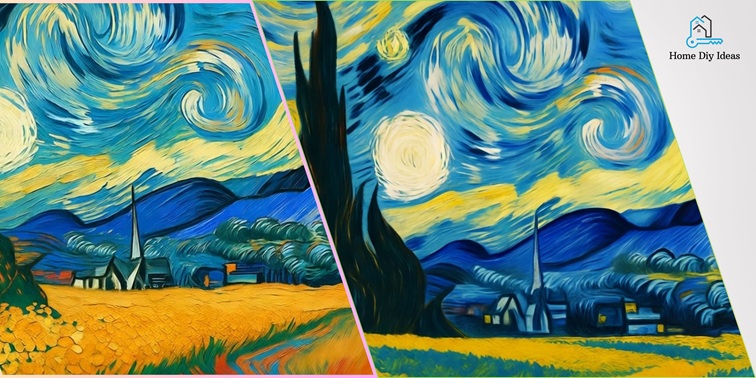
3. Landscaping Inspired by Van Gogh: Practical Steps
3.1 Preliminary Checklist
- ☐ Assess yard size, shape, and existing elements.
- ☐ Test soil and note sunlight patterns.
- ☐ Define three zones: foreground, middleground, background.
- ☐ Choose a dominant colour theme (e.g., golds and blues).
- ☐ Identify a focal feature—like a cypress-style tree or sculpture.
- ☐ Sketch a simple plan before planting.
3.2 Step-by-Step Guide
Step 1: Anchor Your Focal Element
Pick one dominant vertical feature such as a tall tree or ornamental shrub. Place it off-centre for visual energy.
Step 2: Build the Foreground “Field”
Use low, spreading plants or ornamental grasses to form a cohesive base. Warm-toned plants mimic Van Gogh’s wheatfields.
Step 3: Design the Middleground Pathway
Curve your path gently—nature avoids straight lines. Flank it with repeating plant clusters for rhythm and flow.
Step 4: Shape the Background
Frame your house with taller shrubs or trees. Cooler tones—blues, purples, deep greens—create balance against warm foregrounds.
Step 5: Add Colour & Texture
Choose plants that contrast in leaf size and tone. Combine soft grasses with bold-leaf shrubs for texture variation.
Step 6: Maintain the Composition
Mulch to fill gaps, prune regularly, and keep your focal feature visible. A healthy, balanced yard feels like a living canvas.
3.3 Van Gogh Principles Applied to Landscaping
| Van Gogh Principle | Landscaping Translation |
| Bold colour contrasts | Pair warm yellows with cool blues or purples. |
| Layered depth | Create three zones: front, middle, back. |
| Repetition and rhythm | Plant in groups of 3 or 5 for flow. |
| Expressive movement | Choose plants that sway or ripple in wind. |
| Emotional connection | Add a seating area to experience your design. |
3.4 Real-World Applications
- Small front yards: Use golden ornamental grasses, one feature tree, and a winding path for visual depth.
- Shady spaces: Replace golden tones with variegated greens and silver foliage for soft contrast.
- Budget projects: Focus on one bold focal tree and mass low-cost grasses to achieve texture and rhythm.
3.5 Maintenance Checklist
- Maintain proper plant spacing to prevent overcrowding.
- Refresh mulch yearly to preserve colour harmony.
- Prune focal trees to retain shape.
- Replant or adjust perennials seasonally for balance.
4. Beginner-Friendly Front Yard Landscaping Tips
- Start small—refine one zone at a time.
- Curved lines look more natural than straight ones.
- Group plants in odd numbers.
- Use movement and contrast to keep the design alive.
- Limit your colour palette to two dominant tones for cohesion.
- Plan maintenance from the start—choose climate-appropriate plants.
- Make the house your canvas: let landscaping highlight, not hide, it.
5. FAQ – Front Yard Landscaping Inspired by Van Gogh
Pick a tree with distinctive shape or texture. Plant it slightly off-centre so it draws attention naturally.
Use shade-tolerant plants with interesting leaf colour or pattern. Keep the same layered structure even with different species.
Limit yourself to one warm and one cool tone, balanced by plenty of greenery or neutral mulch.
Yes—start with structure (focal tree, beds, pathway) and fill in over time. Choose perennials and native plants for long-term savings.
Moderate. Seasonal pruning, yearly mulching, and routine watering are enough to maintain structure and vibrancy.
Conclusion
Van Gogh’s landscapes remind us that nature is not static—it moves, breathes, and tells stories. You can bring that same life into your yard. By combining colour, rhythm, and emotion, your garden becomes an expressive space rather than just decoration.
Take a notebook, sketch your layout, and imagine how Van Gogh might have painted it. Then bring it to life—plant by plant, brush-stroke by brush-stroke.